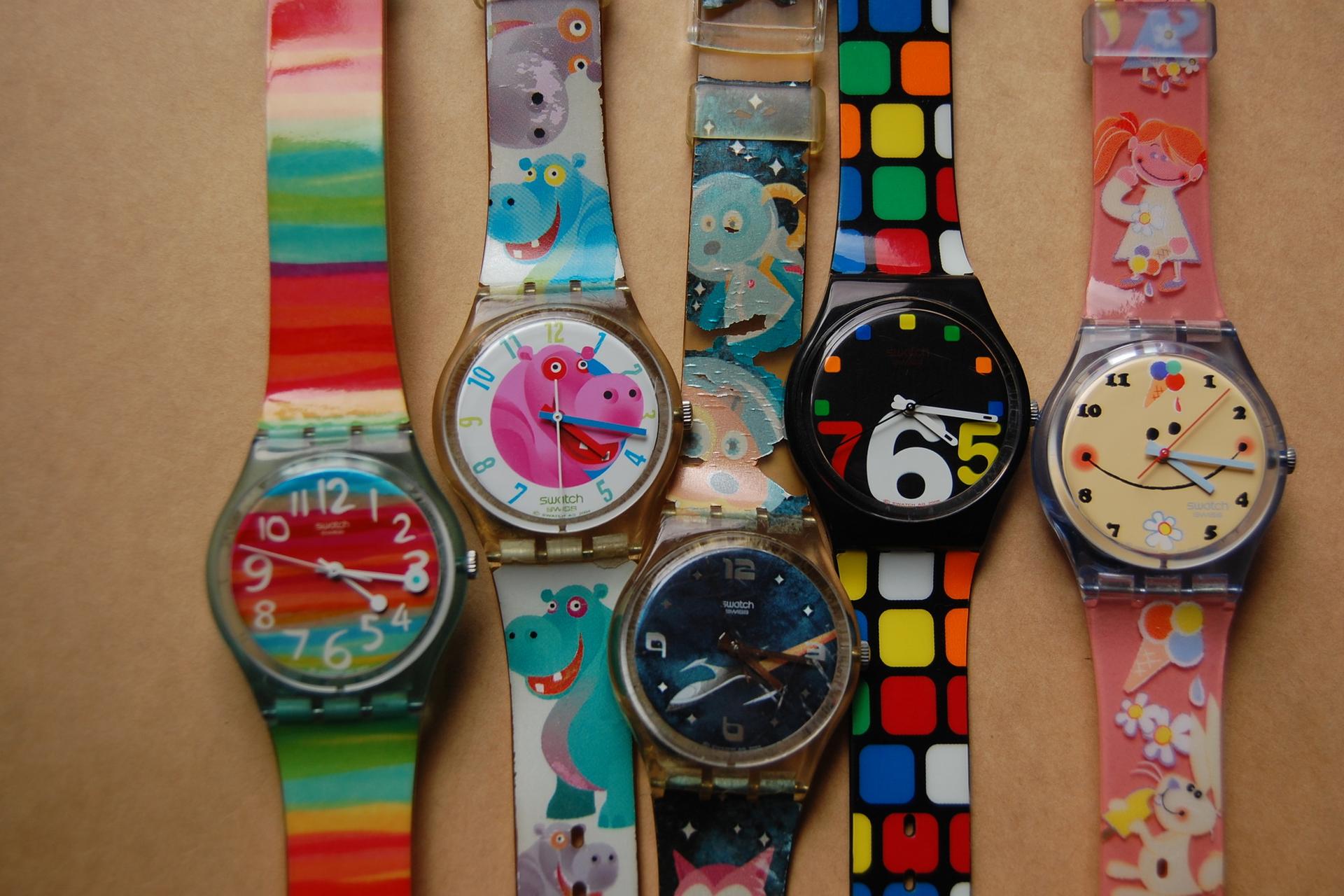
Swatch launched in 1983 as Switzerland's answer to the quartz crisis, when cheap Japanese and American quartz watches had gutted the Swiss industry's share of the mass market. The engineers Elmar Mock and Jacques Müller had worked out how to build an accurate quartz watch from 51 components in a sealed plastic case, roughly half the part count of a conventional watch and cheap enough to assemble by machine. Nicolas Hayek turned that engineering into a brand, positioning the watch as a low-cost, high-design second watch (the name is a contraction of that idea). It sold in the tens of millions and helped fund the recovery of the broader Swiss watch business.
The plastic Swatch grew into a design institution and the anchor of The Swatch Group, the Biel-based conglomerate that also owns Omega, Blancpain, Longines, Tissot, and others. In 2013 Swatch introduced the Sistem51, an automatic movement built from 51 parts held together by a single central screw and assembled entirely by machine, with a roughly 90-hour power reserve. That movement mattered beyond the mainline range: it is the mechanical backbone the brand later adapted for its luxury collaborations, including the hand-wound caliber inside the Royal Pop.
The collaboration era began in March 2022 with the Bioceramic MoonSwatch, a $260 reinterpretation of the Omega Speedmaster Moonwatch in Swatch's ceramic-and-plastic Bioceramic material, sold only in Swatch stores. Eleven planet-named colorways produced queues around the world and reset expectations for what an accessible watch could be. Swatch repeated the formula with the Blancpain x Swatch Scuba Fifty Fathoms in 2023 (five colorways, one for each ocean, at $400) and again with the Audemars Piguet x Swatch Royal Pop in 2026. The pattern is consistent: a heritage design from a Swatch Group or partner maison, executed in Bioceramic, priced in the hundreds, and released in-store to deliberately constrained supply.